Posts

Showing posts with the label Kalman filter

Kalman Filter and Change Points, Part 3

Image
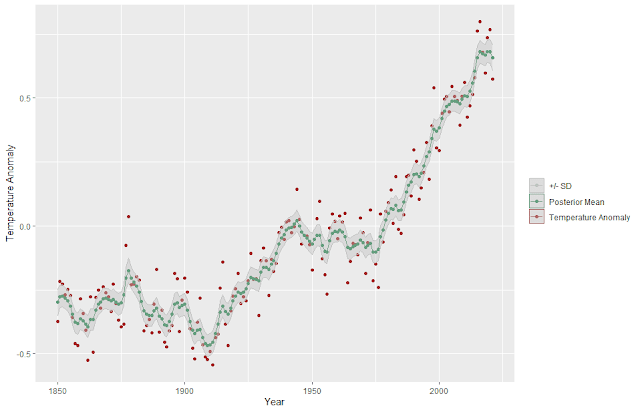
The first step toward change is awareness. The second step is acceptance.  ~ Nathaniel Branden There is nothing permanent except change. ~ Heraclitus I previously looked at the problem of segmenting a time series. Segmenting involves discovering points in the series where there is change. One question arises immediately; when what changes?  In a previous post , we tried to segment the series based on changes to the parameters of a probability distribution or on discovering outliers in the trend discovered by a Kalman filter. Bayesian Change Point Again Here's the data from the previous post. This is  temperature anomaly  data from the   NASA Global Climate Change  site. We could think of this data as a series of linear segments. Each segment has a mean. The data in each segment is scattered around the linear line segments. Within each segment, we assume the mean is constant. The mean is described by an intercept and slope. The data points are scatt...
Kalman Filter and Change Points, Part 2

Image
In a  previous post , I looked at the problem of combining the Bayesian Change Point algorithm with the Kalman filter. The results of applying the method to temperature anomaly data were less than spectacular. With Bayesian change point algorithm, we assume that a change point represents a change in the marginalized probability of the data. There are other ways of thinking about what a change point means. A change point could be considered an anomaly or outlier in the data. To get an idea of how outliers could be detected, consider a simple linear trend Kalman filter. \[\begin{array}{l}{y_t} = {\theta _t} + {\upsilon _t}\,\,\,\,\,\,{\upsilon _t} \sim N(0,V)\\{\theta _t} = {\theta _{t - 1}} + {\omega _t}\,\,{\omega _t} \sim N(0,{W_t})\end{array}\] In this model, we are assuming that the variances don't vary with time, but are drawn from some distribution, typically an inverse-gamma distribution . \[{V_t} = \frac{1}{{{\phi _y}}}\,\,\,\,{W_t} = \frac{1}{{{\phi _\theta }}}\] ${\ph...

Kalman Filter and Change Points

Image
One should clearly distinguish between two aspects of the estimation problem: (1) The theoretical aspect. Here interest centers on: (i) The general form of the solution. (ii) Conditions which guarantee a priori the existence, physical realizability, and stability of the optimal filter. (iii) Characterization of the general results in terms of some simple quantities, such as signal-to-noise ratio, information rate, bandwidth, etc... (2) The computational aspect. The classical (more accurately, old-fashioned) view is that a mathematical problem is solved if the solution is expressed by a formula. It is not a trivial matter, however, to substitute numbers in a formula. The current literature on the Wiener problem is full of semi-rigorously derived formulas which turn out to be unusable for practical computation when the order of the system becomes even moderately large...  ~ Rudolf E. Kalman In a pair of previous posts ( here and here ) I looked at examples of simple Kalman Filter...