Posts

Delta Subvariant AY.4.2

Image
IN OCTOBER 2019, just a few months before the novel coronavirus swept the world, Johns Hopkins University released its first Global Heath Security Index, a comprehensive analysis of countries that were best prepared to handle an epidemic or pandemic. The United States ranked first overall, and first in four of the six categories—prevention, early detection and reporting, sufficient and robust health system, and compliance with international norms. That sounded right. America was, after all, the country with most of the world’s best pharmaceutical companies, research universities, laboratories, and health institutes. But by March 2020, these advantages seemed like a cruel joke, as Covid-19 tore across the United States and the federal government mounted a delayed, weak, and erratic response. By July, with less than 5% of the world’s population, the country had over 25% of the world’s cumulative confirmed cases. Per capita daily death rates in the United States were ten times higher than...

Variants of Concern for September

Image
The secret of change is to focus all of your energy, not on fighting the old, but on building the new. ~ Socrates On 2021-09-24, I downloaded the COVID-19 metadata file from GISIAD . The file contains a whopping 3,795,999 records. The records refer to individual SAR-COV-2 genome sequences uploaded. This is an unprecedented scientific effort and an amazing resource. To get a since of whir can be don with such a large collection  of data I suggest checking out this YouTube video by Trevor Bedford from the Fred Hutchinson Cancer Research Center. In this post, I want to continue exploring variants of concern (VOC) in the US. There are 1,085,764 sequences with Location labeled as "USA". First, the log of the sequence counts. We see a drop-off in the counts of the Delta variant starting around the end of August 2021. This is probably  because of a lag in the time from collection to upload of the sequences. This is a log plot of sequence counts, so the linear increase in ...

Kalman Filter and Change Points, Part 2

Image
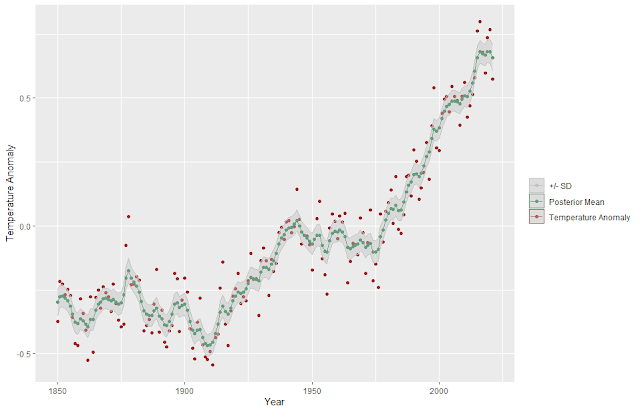
In a  previous post , I looked at the problem of combining the Bayesian Change Point algorithm with the Kalman filter. The results of applying the method to temperature anomaly data were less than spectacular. With Bayesian change point algorithm, we assume that a change point represents a change in the marginalized probability of the data. There are other ways of thinking about what a change point means. A change point could be considered an anomaly or outlier in the data. To get an idea of how outliers could be detected, consider a simple linear trend Kalman filter. \[\begin{array}{l}{y_t} = {\theta _t} + {\upsilon _t}\,\,\,\,\,\,{\upsilon _t} \sim N(0,V)\\{\theta _t} = {\theta _{t - 1}} + {\omega _t}\,\,{\omega _t} \sim N(0,{W_t})\end{array}\] In this model, we are assuming that the variances don't vary with time, but are drawn from some distribution, typically an inverse-gamma distribution . \[{V_t} = \frac{1}{{{\phi _y}}}\,\,\,\,{W_t} = \frac{1}{{{\phi _\theta }}}\] ${\ph...

Kalman Filter and Change Points

Image
One should clearly distinguish between two aspects of the estimation problem: (1) The theoretical aspect. Here interest centers on: (i) The general form of the solution. (ii) Conditions which guarantee a priori the existence, physical realizability, and stability of the optimal filter. (iii) Characterization of the general results in terms of some simple quantities, such as signal-to-noise ratio, information rate, bandwidth, etc... (2) The computational aspect. The classical (more accurately, old-fashioned) view is that a mathematical problem is solved if the solution is expressed by a formula. It is not a trivial matter, however, to substitute numbers in a formula. The current literature on the Wiener problem is full of semi-rigorously derived formulas which turn out to be unusable for practical computation when the order of the system becomes even moderately large...  ~ Rudolf E. Kalman In a pair of previous posts ( here and here ) I looked at examples of simple Kalman Filter...